Can You Put A Mattress At The Curb In Massachusetts?
We connect you with independent Western Mass junk haulers. We are not a hauler.
No. Since 1 November 2022 it has been illegal to throw away a mattress or box spring in Massachusetts, under 310 CMR 19.017. Landfills, transfer stations and waste to energy plants are all prohibited from accepting them.
Most people find this out in one of two ways. Either the trash crew leaves it on the sidewalk, or they load it into a car, drive to the transfer station and get turned around at the gate. Both are avoidable, and the second one is a wasted Saturday.
What counts as a mattress
The definition at 310 CMR 19.006 is any resilient material, or combination of materials, enclosed by ticking, that is intended for sleeping upon. That is deliberately broad and it covers every size. There is no small mattress exception, so a crib mattress is treated the same as a king.
A box spring or foundation counts as its own separate item. So a bed is two items and two fees, which is the single most common surprise on a quote.
What is excluded
- Mattress pads
- Mattress toppers
- Pillows
- Waterbeds
- Air mattresses
- Futon mattresses
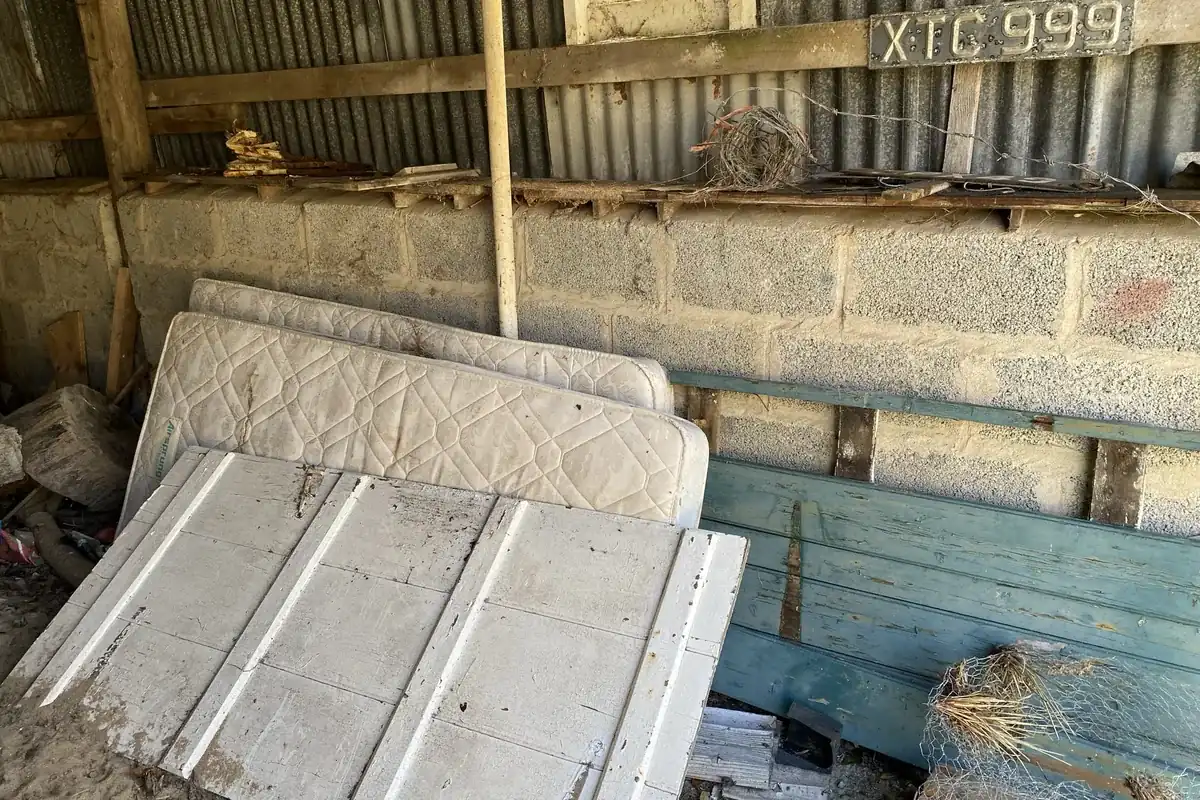
Those are all ordinary trash. There is also a contamination exemption: a mattress with mold, bodily fluids, insects, oil or hazardous substances on it is exempt from the ban and may be disposed of. If yours came out of a flooded basement, that changes the answer.
Check whether your town does it free, first
We would rather tell you this than sell around it. MassDEP has funded mattress recycling programs in 137 municipalities, and roughly 63 percent of the state now has access to one through their own town. If yours is in that group, the drop off may cost you nothing.
Which also means about 37 percent of the state does not have access, and the arrangements differ enormously between neighboring towns. Here is what three of the larger ones in this region actually do.
Springfield
Springfield collects mattresses at the curb, but only for residents and properties paying the city's annual trash fee. It costs two stickers per item at $8 each, so $16 per mattress and $16 more for the box spring. That rate took effect on 4 February 2025.
The mattress also has to be sealed in a plastic mattress bag, which you buy yourself. Collection is by advance phone request through 311, and stickers are sold at Big Y supermarkets and the City Hall Clerk's Office on Court Street.
Holyoke
Holyoke does not collect mattresses at the curb at all. It does not collect furniture, appliances, televisions or computers either. There is a drop off at the Department of Public Works on Canal Street, open Tuesday and Thursday, which requires a Refuse Disposal Card and a vehicle.
In a city where roughly 71 percent of households rent, and much of the housing is three and four story walk ups built between 1850 and 1890, that is a real problem rather than a technicality.
Chicopee
Chicopee takes mattresses and box springs at its drop off center on Baskin Drive, which is open to residents Tuesday through Saturday. It also runs a curbside bulk pickup program that covers mattresses and is scheduled online through the city's permit system.
Fees and hours change. Check your own town's public works page before you drive anywhere, and call rather than assume if the page is ambiguous.
Why there is a fee at all when it gets recycled
Because taking one apart is hand labor. Somebody strips the ticking, separates the foam and fiber padding, pulls out the wooden frame and cuts out the steel spring unit. Over 75 percent of a mattress by weight ends up recovered.
The steel is worth something at scrap. The foam becomes carpet underlay. The wood gets chipped. The fiber goes into filters and insulation. But the labor costs more than the recovered material is worth, and that gap is the fee on your quote. It is a recycling cost, not a markup.
The scale of it
Massachusetts throws out roughly 600,000 mattresses a year, about 200,000 of them from households. They are bulky, they do not compact, and they wrap around the machinery at a transfer station. The ban was as much an operational decision as an environmental one.
The stairs problem
This is the practical thing nobody warns you about. A queen box spring will not turn on a standard stairwell landing. It went up when the room was empty and the angles were different, and it will not reliably come back down.
The usual answers are cutting the wooden frame of the box spring so it folds, or taking it out a window. Both are normal. A split foundation is what to buy next time if you are on an upper floor. A king memory foam mattress is a different problem: roughly 100 to 140 pounds of floppy weight that two people have to control on a staircase.
Before anybody collects it
- Strip the bedding off. Sheets, blankets and pillowcases are textiles, banned separately on the same date, and a pile of linens left on top can add to your quote
- If it is wet, say so. Recyclers reject soaked mattresses, and a rained on mattress may fall under the contamination exemption instead
- If there is any chance of bed bugs, say so on the phone. It gets bagged on site so it does not contaminate the truck or the recycling facility
- Check your town first. If yours runs a free collection, use it
When paying somebody makes sense
When you cannot move it. That is the honest answer. A single mattress as a standalone trip means paying a hauler's minimum charge, usually $125 to $175 around here, or $75 to $150 as a flat item fee from some operators.
The people for whom that is worth it are the ones on a third floor with no elevator, without a vehicle that fits a king mattress, or without a free weekday to spend at a drop off center. If you have a pickup and a Saturday and your town takes them, use your town.


Get a free quote from a local junk hauler
Tell us what needs to go. We pass it to one independent hauler who works your town, and they give you a price. No fee, no contract, and nobody else gets your number.
Call Now(413) 505-8565We connect you with independent Western Mass junk haulers. We are not a hauler.